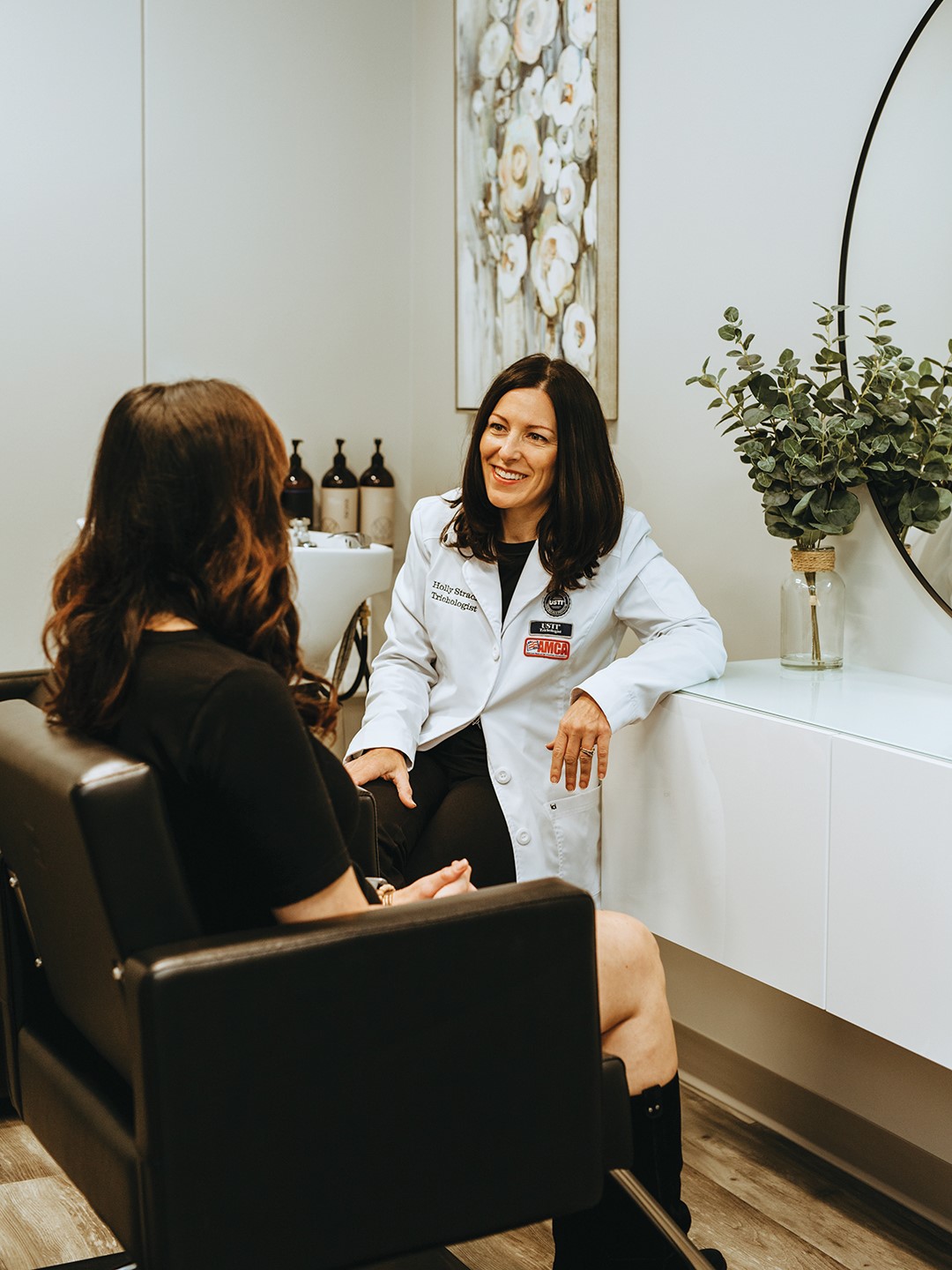
Holly Strack and a client talk through a personalized plan to combat hair loss. Photo: Elle Anna Photography
Holly Strack helps women uncover the causes of hair loss.
While hair loss is often seen as a concern primarily affecting men, an increasing number of women are experiencing it, too. Trichologists like Holly Strack are helping to change the conversation by offering expertise and expanding options for treatment. Though not medically licensed, trichologists are certified professionals trained to address hair and scalp issues. “I’m basically a liaison between a hair stylist and a dermatologist,” Strack says
The broad medical term for hair loss is alopecia, but the condition can manifest in a myriad of ways. Strack says people tend to write off their hair loss as genetic, but the loss may be a result of hormone imbalances, nutrition or—most commonly in recent years—stress. She urges people not to blame their hair loss on genetics or specifically on their mother’s father, a common misconception. Hair loss, when genetic, can come from anyone in the family, skip a generation or manifest at different points in life. Both men and women can begin losing hair as early as their teen years.
To uncover potential causes, Strack conducts a detailed examination of the hair and scalp using a dermascope during first appointments, which collects data on the hair follicles and the condition of the scalp. Clients can also opt to receive an ALO test, a cheek swab that takes a sample of their DNA to look at 26 genetic markers for hair growth. She also offers an epigenetic hair follicle analysis, which looks at how overall health is affecting the hair. Before any appointment, clients fill out an intake form about their lifestyle and medical history. Strack schedules long appointments to discuss treatment plans and adjustments to lifestyle, so people have space to discuss their experiences.
One of Strack’s clients, Kendra, has had thick hair for most of her life, and the prospect of losing it was scary. “It’s so reassuring to know I have Holly in my corner when it comes to doing all I can to maintain and improve my hair and scalp. She’s incredibly knowledgeable, easy to talk to and someone I trust,” Kendra says.
There is no one-size-fits-all treatment for alopecia. Kendra’s journey has included topical products and mindfulness of her physical and mental health. She has also done three TransEpidermal Delivery (TED) treatments, which allow topical hair growth applications to penetrate deeper into the follicles without needles, as well as a low-level laser therapy cap. TED uses sound waves and air pressure to infuse amino acids, peptides and other growth factors into the hair follicles.
Some clients continue treatment with Strack, but she arms her clients with the knowledge, practices and tools to tackle hair loss on their own without her services if desired. Nonsurgical hair loss recovery is a marathon, not a sprint, and takes time, she says. Strack uncovers the likely causes and advises on next steps—whether that’s TED treatment, microneedling, lifestyle adjustments or visiting a dermatologist for a prescription, biopsy and next steps.
Hair benefits from preventative care, just like skin, and Stack says people do not have to wait for hair loss to visit a trichologist. “Your hair is the first signal that something is off. We can do these types of treatments regardless, to help remind the body what to be doing,” she says.
Above all, Strack urges people to break their silence on hair loss fears. “You’re not alone. Talk to somebody about it. Tell a friend; they can help you. If it’s bothering you, there’s something you can do about it. Don’t wait,” she says.
Holly Strack Trichologist
Instagram: @hollystrack